Free shipping on all orders

Last Updated: November 13, 2026
Quick Summary
Yes, lightweight foundation is often a better choice for sensitive skin than a heavy, full-coverage formula, but only when the formula itself is built for reactive skin. Texture alone does not make a product gentle, so look for a fragrance-free formula with a short ingredient list and no drying alcohol or essential oils.
- A thin, watery foundation loaded with fragrance and drying alcohol can irritate skin faster than a richer, soothing formula.
- Fragrance and essential oils are the most common cause of contact irritation in cosmetics.
- Patch testing takes three days: apply a pea-sized dot and leave it for 24 hours.
- Apply with clean fingers or a damp sponge and press the product in rather than buffing.
- Test oxidation with a one-day wear trial on half the face, checking at midday and late afternoon.
Table of Contents
- The Short Answer on Lightweight Foundation and Sensitive Skin
- What Makes a Foundation Gentle Enough for Reactive Skin
- The Best Lightweight Foundation for Sensitive Skin Comes Down to Formula
- Dermatologist Recommended Foundation for Sensitive Skin: What That Label Really Means
- Lightweight Foundation for Oily Skin That Won't Trigger Breakouts
- Lightweight Foundation for Daily Use: Coverage, Wear Time, and Oxidation
- How to Patch Test and Apply Foundation on Reactive Skin
- Build Your Sensitive-Skin Routine With Anjelic Beauty
- Frequently Asked Questions
The Short Answer on Lightweight Foundation and Sensitive Skin
Yes, lightweight foundation is often a better choice for sensitive skin than a heavy, full-coverage formula, but only when the formula itself is built for reactive skin.
At Anjelic Beauty, customers tell us the same story: years of cycling through base products that triggered redness or oxidized orange by mid-afternoon.
Lightweight foundation is a liquid or serum-based base product formulated to feel thin and breathable on the skin while providing light-to-medium coverage.
That definition separates two things shoppers confuse: how a foundation feels and how it behaves on reactive skin. Breathable wear is a texture claim; a gentle formula is an ingredient claim. You need both.
If you are still building out a sensitive-skin makeup routine, our vegan makeup for sensitive skin guide walks through the full product stack before you commit to a base.
What Makes a Foundation Gentle Enough for Reactive Skin
A foundation earns the "gentle" label through what it leaves out, not what it adds. The most reliable markers are a fragrance-free formula, a short ingredient list, and the absence of common triggers like drying alcohols and essential oils.
Sensitive skin reacts to a narrower band of ingredients than most shoppers expect, and irritation is usually cumulative. A formula that feels fine on day one can cause breakouts after a week of daily wear, which is why patch testing matters more than first impressions.
Here is how we would sort the ingredient list on any liquid foundation before buying:
- Fragrance and essential oils: the most common cause of contact irritation in cosmetics, and entirely unnecessary in a base product.
- Denatured alcohol high on the list: speeds up drying and can strip the skin barrier over repeated use.
- Heavy silicone load: not inherently irritating, but can trap oil and contribute to breakouts on oily and combination skin.
- Soothing ingredients: niacinamide, glycerin, and ceramides support the barrier while the pigment sits on top.
- Minimal preservative systems: fewer actives means fewer chances for a skin reaction.
Ingredients That Soothe and Ingredients That Sting
The soothing side is short and well understood: glycerin pulls water into the skin, niacinamide supports the barrier and can calm visible redness over time, and ceramides help rebuild what reactive skin loses. None of these make a foundation a treatment, but they make daily wear more comfortable.
The stinging side is longer. Fragrance, citrus oils, menthol, and high concentrations of denatured alcohol are the usual suspects. Watch out: a product marketed as "hypoallergenic" can still contain fragrance, because the term has no legal definition in cosmetics. Read the label, not the front of the bottle.
The Best Lightweight Foundation for Sensitive Skin Comes Down to Formula
The best lightweight foundation for sensitive skin is the one with the fewest known irritants and a finish that does not require heavy layering to look even.
Most shopping guides get this wrong, ranking foundations by finish and shade range and mentioning sensitivity as an afterthought. For reactive skin, reverse the order: ingredient safety first, then finish, then shade.
Our own approach with the AuraAlign™ Liquid Changing Foundation reflects that priority.
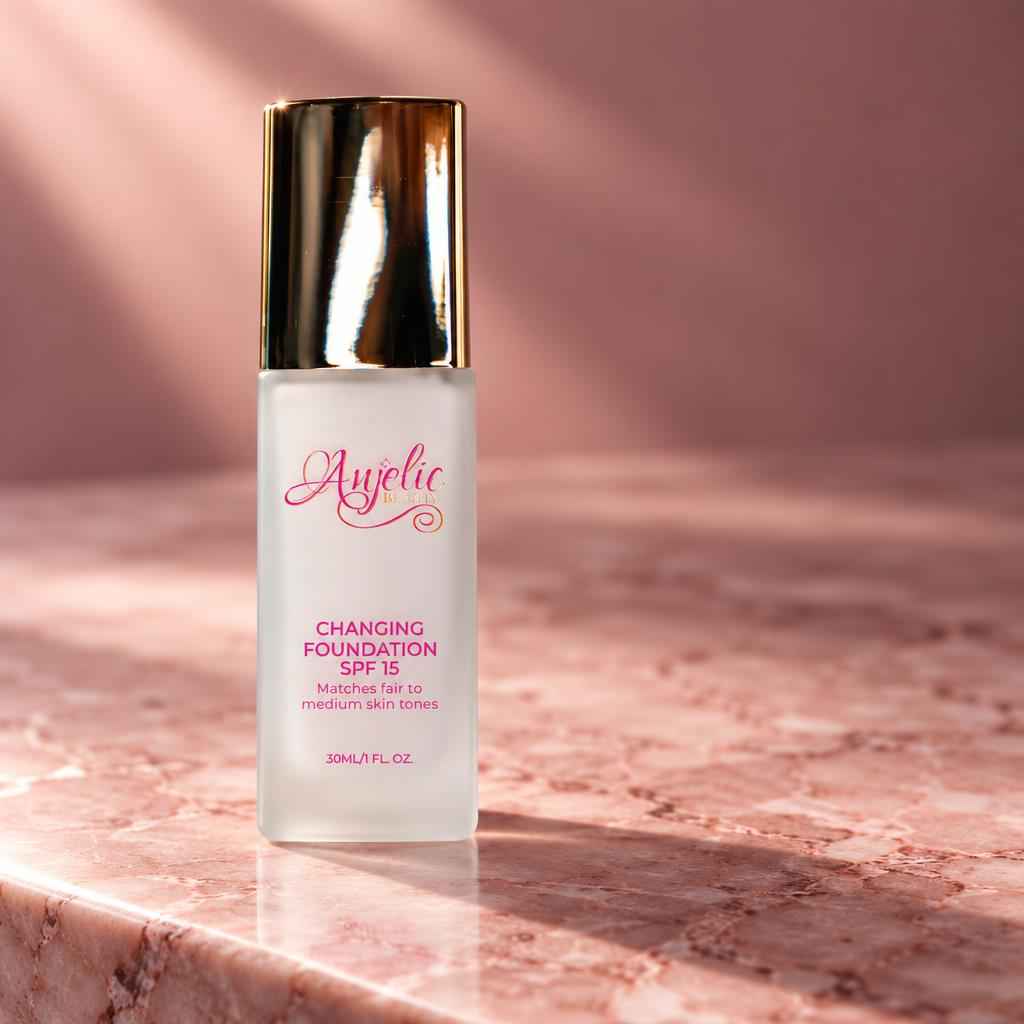
One honest limitation: adaptive pigment technology is not a substitute for a proper patch test. No formula, however gentle, is guaranteed to suit every reactive skin type.
Dermatologist Recommended Foundation for Sensitive Skin: What That Label Really Means
"Dermatologist recommended" is a marketing claim, not a regulatory one. No US authority verifies who recommended a product, how many dermatologists were involved, or whether the recommendation came from a paid partnership.
That doesn't make the labels meaningless, treat them as one signal among several, not proof. A fragrance-free product with a short ingredient list and a dermatologist-tested claim is a stronger candidate than one leading with the claim alone.
What actually helps you decide:
- Look for fragrance-free rather than "unscented," which can still contain masking fragrance.
- Check whether the brand publishes its full ingredient list, not just the hero actives.
- Prefer formulas described as non-comedogenic if you are prone to breakouts.
- Treat "clean" as a marketing word with no fixed definition, and read the ingredients instead.
The FDA's guidance on cosmetic labeling is a useful reference for understanding what companies are and are not required to disclose. It will not tell you which foundation to buy, but it will tell you how much of the front-label language is unregulated.
Lightweight Foundation for Oily Skin That Won't Trigger Breakouts
Lightweight foundation for oily skin has a different job than it does for dry skin.
Start by reading the emollient and silicone load.
The most common mistake is oily-skinned shoppers reaching for matte, long-wear formulas to stop midday shine.
Here is how we would sort a lightweight formula for oily and combination skin before buying:
- Water or glycerin high on the list: signals a fluid, breathable base rather than an oil-heavy cream.
- Niacinamide in the top half of the list: supports the barrier and is commonly used in oil-control formulas; it does not make the product a treatment, but it is a reasonable supporting ingredient.
- Salicylic acid or zinc: sometimes added for blemish-prone skin; treat these as bonus signals, not guarantees, and patch test if you are reactive.
- Heavy powder load: a long list of talc, silica, and mica can blur shine but also settle into texture and feel drying by afternoon.
- Fragrance and essential oils: unnecessary in any base product and a common trigger for reactive, oily skin that is already inflamed.
For combination skin, treat zones differently: apply a lightweight liquid foundation thin across the whole face, then set only the T-zone.
Watch out: if your foundation separates or goes patchy on oily areas by early afternoon, the culprit is often the primer or setting step, not the foundation.
If breakouts are your main concern rather than shine, the same ingredient logic applies but the stakes are higher.
Lightweight Foundation for Daily Use: Coverage, Wear Time, and Oxidation
Lightweight foundation for daily use has to survive a full workday without touch-ups, and that is where oxidation becomes the real test.
The mechanism matters because it changes how you shop.
Coverage level and wear time pull against each other. Sheer coverage fades gracefully. Full coverage holds longer but shows every crack when it breaks down.
| Coverage Level | Best For | Wear Pattern | Sensitivity Risk |
|---|---|---|---|
| Sheer | Minimal makeup days | Fades evenly, needs blotting | Lowest |
| Light-to-medium | Daily office wear | Holds with a primer base | Low |
| Medium | Redness and uneven tone | Can settle into texture | Moderate |
| Full | Event coverage | Requires touch-ups | Highest |
Oxidation is the single most common complaint from customers with deeper skin tones, where an oxidizing formula often turns ashy rather than orange, a cooler, grayer cast that reads as a dull film. If your base turns ashy or orange by lunch, our explainer on why foundation turns orange breaks down the chemistry and what to do about it.
Watch out: a formula that looks perfect in the morning and shifts by 2 PM is not a shade-matching problem you can solve by buying a lighter or darker bottle.
How to Patch Test and Apply Foundation on Reactive Skin
Patch testing is the only reliable way to find out whether a foundation suits your skin before you commit to a full face of it. The process takes three days and costs nothing but patience.
Here is the routine we recommend, step by step:
- Choose the test site. The inner forearm or the side of the jaw, on clean, dry skin.
- Apply a small amount. A pea-sized dot, spread thin, exactly as you would wear it.
- Leave it for 24 hours. Do not wash the area. Note any stinging, itching, or redness.
- Repeat on day two and day three. Reactions are often cumulative, not immediate.
- Test the full face on day four. Apply to half the face first if you are highly reactive.
- Watch for delayed breakouts. Clogged pores can take a week to appear.
- Stop at the first sign of irritation. Redness, swelling, or a burning sensation means the product is not for you.
Application matters as much as testing. On reactive skin, apply with clean fingers or a damp sponge and press the product in rather than buffing, friction is a trigger.
For a more detailed walkthrough, our seven-step patch test guide covers timing, test sites, and what different reactions mean.
Build Your Sensitive-Skin Routine With Anjelic Beauty
The throughline is simple: sensitive skin doesn't need fewer products, it needs fewer unknowns. A short ingredient list, a fragrance-free formula, and a base that doesn't shift color by mid-afternoon will do more than any single hero product.
That's the problem we set out to solve. Our Complexion Trinity pairs the AuraAlign™ adaptive foundation with the AuraPrep™ 3-in-1 Color-Correcting Primer, a hydrating base built to block the oils that cause midday oxidation.
If you have been burned by shade guessing before, start with the primer and foundation pairing and build from there. Get started with Anjelic Beauty and give your skin a base that stays true from morning to night.
Frequently Asked Questions
What type of foundation is best for sensitive skin?
Liquid and serum foundations with short ingredient lists tend to suit reactive skin better than powder or full-coverage cream formulas, which can cake over dry patches and trap irritation. Look for fragrance-free, hypoallergenic formulas with soothing ingredients like niacinamide or glycerin, and avoid heavy silicone binders that can clog pores. A lightweight foundation with a breathable texture gives you even coverage without the heavy feel that often triggers redness or breakouts by midday.
Can lightweight foundation still irritate sensitive skin?
Yes. A light texture does not guarantee a gentle formula. Some sheer foundations rely on fragrance, alcohol, or certain preservatives that can cause stinging, redness, or breakouts within hours. Check the ingredient list before you buy, and patch test on your jawline or inner forearm for 48 hours before applying to your full face. If you notice a skin reaction, stop use and let your skin settle before trying another product.
How do you patch test foundation on sensitive skin?
Apply a small amount to your inner forearm or along your jawline, then leave it for 24 to 48 hours without washing it off. Watch for redness, itching, or small bumps. If your skin stays calm, test again on half your face for a full day of wear, since heat and your skin's natural oils can change how a formula behaves. This two-step approach catches most irritation before it reaches your whole complexion.
What ingredients should sensitive skin avoid in foundation?
Watch for added fragrance, drying alcohols, essential oils, and aggressive preservatives, all of which are common potential irritants. If you have rosacea or frequent breakouts, also be cautious with heavy occlusive ingredients that trap heat and oil. Instead, look for soothing ingredients such as glycerin, niacinamide, and ceramides, plus labels that say fragrance-free and hypoallergenic. A gentle formula with fewer ingredients lowers your odds of a reaction.
Is lightweight foundation suitable for oily, sensitive skin?
It can be, provided the formula is oil-balancing and non-comedogenic. Oily skin paired with sensitivity needs breathable wear and shine control without drying alcohol, which can trigger rebound oil and irritation. A soft-matte or natural finish liquid foundation applied in thin layers, set only where you shine, gives you coverage without the heavy feel. Pair it with a hydrating primer to block your skin's oils from breaking down the pigment and causing oxidation.