Free shipping on all orders
Table of Contents
- Why Deep Skin Tones Need Specialized Vegan Foundation
- Vegan Foundation Undertones Explained: Finding Your True Match
- How to Color Match Deep Skin Foundation Without Oxidation
- Non-Oxidizing Vegan Foundation: Technology That Holds True
- What to Look for in Vegan Foundation for Deep Skin
- Anjelic Beauty's Approach: Smart Glam System for Melanin-Rich Skin
- Application Tips for a Flawless, Long-Lasting Finish
- Conclusion
Last Updated: August 28, 2026
Why Deep Skin Tones Need Specialized Vegan Foundation
Finding the right foundation is never simple, but for women with deep skin tones, the challenge becomes exponentially harder. The vegan cosmetics market has exploded in recent years, valued at USD 20.48 billion in 2025 and projected to reach USD 37.43 billion by 2034, registering a CAGR of 6.94% over the forecast period (researchandmarkets.com). The vast majority of vegan foundation options still fail to deliver true color matches for melanin-rich skin. According to research, online retail has become a dominant distribution channel with a 39.22% market share in 2025, and is projected to grow at a CAGR of 17.45% through 2031. But more options doesn't mean better options if they're not formulated with your undertone in mind.
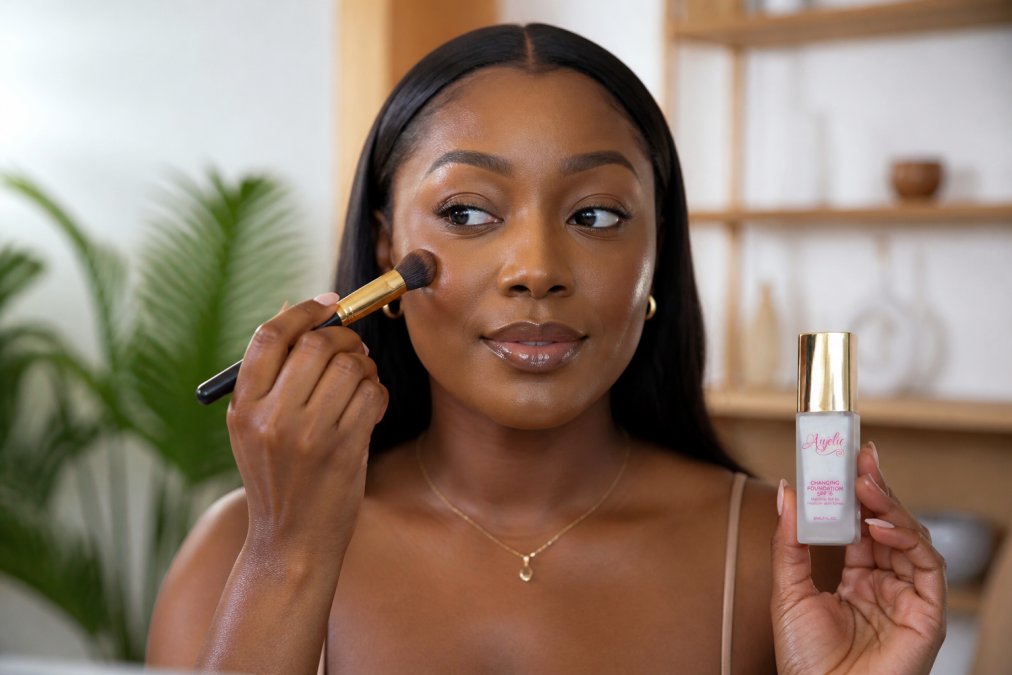
The real problem isn't a lack of vegan foundations, it's that most brands design their shade ranges around lighter skin tones first, then attempt to extend downward. This approach creates two persistent issues: oxidation (where the foundation turns orange or ashy within hours) and undertone mismatches that leave you looking gray or washed out. The answer lies in understanding that deep skin tones require different pigment formulations, different coverage strategies, and a completely different approach to how color is engineered.
This guide covers exactly what to look for in a vegan foundation specifically designed for deep skin, how to match your undertone without guesswork, and which products actually deliver non-oxidizing color from morning through night.
Vegan Foundation Undertones Explained: Finding Your True Match
Your undertone is the subtle hue beneath your skin's surface, the foundation of every makeup choice you make. Most women with deep skin tones have been told their undertone is either "warm" or "cool," but that oversimplification has led to countless mismatches. The undertone spectrum is far more nuanced, especially for melanin-rich skin where undertones can shift dramatically depending on lighting and the specific pigments in your foundation.
Warm, Cool, and Neutral Undertones
Warm undertones contain golden, peachy, or reddish hues. If you have warm undertones, your skin tends to look better next to gold jewelry, warm lighting, and foundations with yellow or red-based pigments. For deep skin tones with warm undertones, this means seeking foundations with ochre, golden, or warm brown pigments, not the orange-tinted shades that oxidize into something unrecognizable by afternoon.
Cool undertones lean toward pink, red, or blue hues. Cool-toned deep skin looks luminous next to silver jewelry and cool lighting. Foundations for cool undertones should contain red, violet, or blue-based pigments to prevent that ashy, gray appearance that happens when the wrong undertone is applied.
Neutral undertones balance warm and cool pigments equally. If you have neutral undertones, you're fortunate in that you can wear both warm and cool foundations, but you still need them to be formulated for deep skin, not just a darker shade of a formula designed for light skin.
The Olive Undertone Challenge
Here's where most guides fail: olive undertones. Olive skin has green or gray undertones mixed with warmth, and it's remarkably common in deep skin tones. Yet most vegan foundation brands either ignore olive completely or attempt to address it with a single shade that doesn't account for the depth variations within the olive family.
Olive undertones require foundations with specific pigment balancing, typically a combination of yellow and red pigments that create that characteristic green cast. Too much yellow, and you look sallow. Too much red, and you veer into warm territory and lose the olive entirely. This is where vegan cosmetics formulation research shows that brands investing in undertone-specific pigmentation see significantly better customer retention and satisfaction than those using generic shade extensions.
How to Color Match Deep Skin Foundation Without Oxidation
Oxidation is the enemy of foundation longevity for deep skin tones. It's the chemical process where your skin's natural oils interact with the foundation's pigments and binders, causing the color to shift, usually toward orange, ash, or an unnatural gray. For women with deep skin, oxidation is more visible and more problematic because the shift is dramatic and nearly impossible to hide with powder.
Swatching on Actual Skin
Never swatch foundation on your hand or wrist. Your jawline, neck, and chest have different undertones than your hand, and for deep skin tones, this difference is pronounced. The correct swatch location is your jawline where it meets your neck, this is where you'll actually wear the foundation, and it's where undertone mismatches become immediately obvious.
When swatching, use natural lighting whenever possible. Indoor fluorescent lighting distorts undertones dramatically, especially for melanin-rich skin. If you're shopping online (which 39.22% of vegan cosmetics buyers do according to vegan cosmetics distribution data), request samples before committing to a full-size purchase. Most reputable vegan brands offer sample sizes, and the investment in getting the right shade is worth it.
Apply the swatch and let it sit for at least 15 minutes. This is how long it takes for the foundation to begin interacting with your skin's natural oils. If the color shifts noticeably within that window, oxidation is happening, and this shade isn't formulated for your skin chemistry.
Understanding Oxidation and Ashiness
Oxidation and ashiness are related but distinct problems. Oxidation is chemical, the foundation's pigments reacting with your skin. Ashiness is visual, when the undertone of the foundation doesn't match your skin, creating a gray or dull appearance that reads as "ashy" or "lifeless."
For deep skin tones, ashiness often happens because the foundation was formulated with undertones designed for lighter skin, then simply darkened. Darkening a cool-toned formula doesn't automatically make it work for deep cool-toned skin, it can actually make the cool undertone more pronounced, creating that unwanted gray cast.
The best defense against both problems is choosing a foundation specifically engineered for melanin-rich skin with non-oxidizing pigment technology. This is where vegan formulations have an advantage: without animal-derived ingredients like carmine (a red pigment from insects), brands are forced to innovate with synthetic or plant-based alternatives that often perform better on deep skin tones anyway.
Non-Oxidizing Vegan Foundation: Technology That Holds True
The phrase "non-oxidizing" has become marketing shorthand, but it actually refers to specific formulation choices. True non-oxidizing foundations use pigments and binders that don't chemically react with skin oils, and they're formulated with undertones that account for how melanin interacts with color.
Anjelic Beauty's Smart Glam System™ addresses this through True Tone Technology, a proprietary approach to pigment selection and blending that ensures color stays true from application through wear. Rather than using generic undertone categories, the Smart Glam System accounts for the complexity of melanin-rich skin by engineering formulas across 40+ tones, each tested on actual deep skin to prevent oxidation and ashiness.

The technology works by balancing synthetic pigments with plant-based actives that support skin health while preventing the chemical breakdown that causes color shift. This means the foundation doesn't just look better, it performs better throughout the day, maintaining its finish without fading or shifting.
What to Look for in Vegan Foundation for Deep Skin
When evaluating a vegan foundation, five criteria matter most for deep skin tones: shade range depth, undertone specificity, coverage level, finish type, and ingredient transparency.
Coverage Levels and Finish Options
Coverage comes in four categories: sheer, light, medium, and full. For deep skin tones, sheer and light coverage foundations often look patchy because they can't provide enough pigment to create an even complexion without layering excessively. Medium to full coverage is typically more practical, but the finish matters equally.
Matte finishes can look flat and heavy on deep skin if they're not paired with the right undertone. Dewy finishes often read as "oily" on melanin-rich skin due to how light reflects off deeper complexions. The ideal finish for most deep skin tones is satin or luminous, something that enhances natural radiance without appearing greasy or flat.
Buildable coverage is the sweet spot: a formula that provides medium coverage on first application but allows you to layer for full coverage where needed. This flexibility means you can use one foundation for both full-face wear and targeted coverage over blemishes or hyperpigmentation.
Clean Beauty and Ingredient Safety
Vegan doesn't automatically mean clean, and clean doesn't automatically mean vegan. For deep skin tones, ingredient transparency matters because melanin-rich skin can be more prone to hyperpigmentation and sensitivity when exposed to certain synthetic ingredients.
Look for foundations that are:
- Free from synthetic fragrances (which can trigger irritation)
- Paraben-free
- Non-comedogenic (won't clog pores, which is crucial for preventing breakouts that worsen hyperpigmentation)
- Formulated with actives that support skin barrier health
Hyaluronic acid, niacinamide, and antioxidants like vitamin E are standard in quality vegan foundations. For deep skin, these ingredients do double duty: they keep the foundation from drying out the skin while also supporting the skin barrier, which is essential for preventing the irritation that can lead to post-inflammatory hyperpigmentation.
Cruelty-Free Certification Explained
"Vegan" means no animal ingredients. "Cruelty-free" means the product wasn't tested on animals. These are separate certifications, and both matter. According to consumer research, 35% of consumers actively look for "cruelty-free" claims on beauty products.
Look for official certifications like the Leaping Bunny logo (cruelty-free) or Vegan Action/The Vegan Society logos (vegan). These certifications are third-party verified, meaning the brand has undergone independent audits to confirm their claims. Self-declared cruelty-free or vegan status is better than nothing, but official certifications carry more weight and transparency.
Anjelic Beauty carries both certifications, 100% vegan with zero animal testing, because we believe ethics and performance shouldn't be compromised for marketing claims.
Anjelic Beauty's Approach: Smart Glam System for Melanin-Rich Skin
Anjelic Beauty's AuraAlign™ Liquid Changing Foundation ($40.00) was specifically engineered to solve the oxidation and undertone-matching problems that plague deep skin tones in the vegan beauty market. The foundation uses the Smart Glam System™, which combines skincare-grade actives with vegan pigments formulated to mirror your natural undertone across 40+ shades.
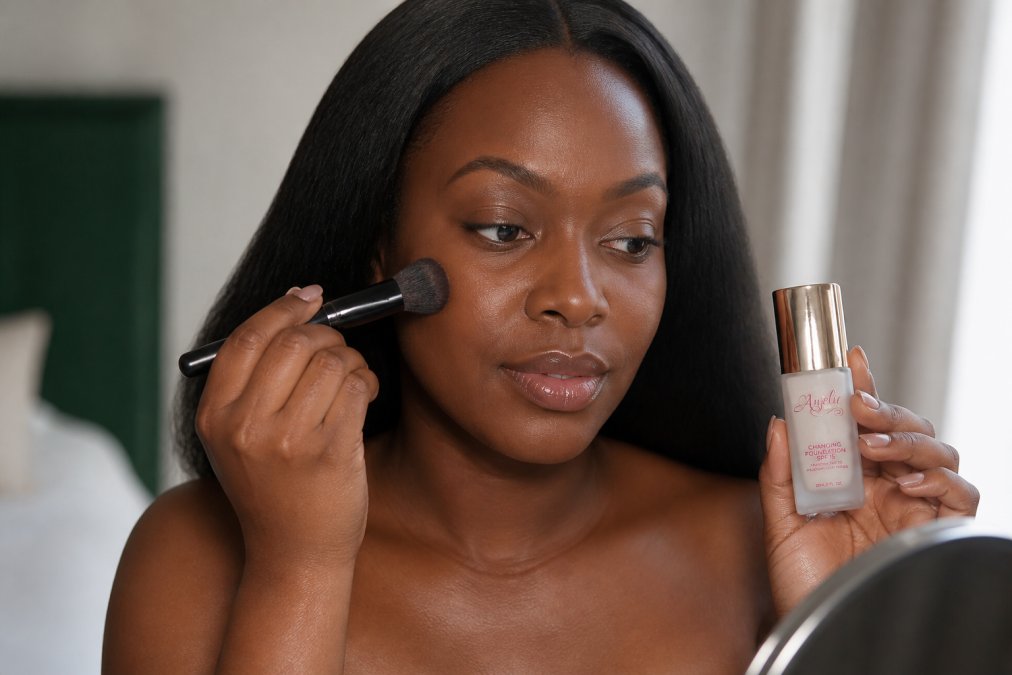
What sets this formula apart is its True Tone Technology, a proprietary pigment-balancing system that prevents oxidation by accounting for how melanin interacts with color. Each shade is tested on actual deep skin tones to ensure it won't shift, fade, or turn ashy throughout the day. The formula includes hyaluronic acid for hydration, antioxidants for skin protection, and SPF 15 for daily UV defense.
The coverage is buildable medium to full, and the finish is luminous without appearing greasy, exactly what deep skin tones need. The formula blends effortlessly, adapting to your skin throughout the day rather than sitting on top of it.
Most importantly, it's formulated without synthetic fragrance, parabens, or pore-clogging ingredients. For women with sensitive skin or a history of hyperpigmentation, this matters. The formula supports skin health while delivering flawless color from morning through night.
Application Tips for a Flawless, Long-Lasting Finish
How you apply foundation matters as much as which foundation you choose, especially for deep skin tones where any patchy application becomes immediately visible.
Start with a hydrated, primed base. Use a hydrating primer or serum to ensure your skin is plump and even, this prevents the foundation from clinging to dry patches or settling into fine lines. For deep skin, a luminizing primer can enhance the radiance of your foundation rather than dulling it.
Apply with a damp beauty sponge or dense brush, using a stippling motion rather than buffing. Stippling (pressing the product into the skin rather than dragging it) ensures even coverage without disturbing your skin's natural texture. A damp sponge helps the foundation meld with your skin rather than sitting on top of it.
Build coverage gradually. Start with a light layer across your entire face, then add a second layer to areas that need more coverage. This approach prevents the heavy, cakey appearance that happens when you apply full coverage in one pass.
Set strategically. Use a translucent powder only where you need it, typically the T-zone, to prevent the matte appearance that can look flat on deep skin. For the rest of your face, skip powder and let the foundation's luminous finish shine through.
Touch up throughout the day with a foundation stick or powder if needed, but most quality non-oxidizing foundations designed for deep skin should hold through an 8-10 hour workday without major fading.
Finding the best vegan foundation for deep skin doesn't require endless trial and error. It requires understanding your undertone, knowing what to look for in formulation, and choosing a brand that's actually engineered for melanin-rich skin rather than adapted from lighter shade ranges. Anjelic Beauty's AuraAlign™ foundation delivers exactly that, color that stays true, coverage that lasts, and ingredients that support your skin. Get yours now and experience the difference that True Tone Technology makes.
=== FAQ ANSWERS (audit these too, same rules) ===
[1] Q: How do I know if a vegan foundation will oxidize on my deep skin tone? A: Oxidation occurs when foundation formulas react with skin chemistry, turning orange or ashy. Test foundations on your jawline in natural light for at least 15 minutes to see if the color shifts. Look for non-oxidizing vegan foundations with stable pigment technology, Anjelic Beauty's True Tone Technology is engineered to prevent color shift. Always swatch on actual deep skin, not swatches from lighter skin tones, as oxidation behaves differently across melanin levels.
[2] Q: What's the difference between warm, cool, and olive undertones for deep skin? A: Undertones are the subtle hues beneath your skin surface. Warm undertones have golden, peachy, or red-based hues; cool undertones lean pink, red, or blue; olive undertones contain green or golden-green notes. Deep skin can have any undertone combination. To identify yours, look at your veins, blue/purple indicates cool, green indicates warm or olive, and mixed suggests neutral. Match your foundation's undertone to your skin's undertone, not just the depth. Anjelic Beauty formulates across 40+ shades with undertone-specific pigments to prevent ashiness and ensure true color match.
[3] Q: Why should I choose vegan foundation over conventional options for deep skin? A: Vegan foundations eliminate animal-derived ingredients without sacrificing performance. The vegan cosmetics market is projected to reach USD 37.43 billion by 2034, driven by innovation in non-oxidizing formulas and inclusive shade ranges. Vegan foundations often avoid outdated formulations that oxidize, making them a stronger choice for deep skin tones seeking long-wear color that stays true from morning to night.
[4] Q: Are vegan foundations as long-wearing as conventional makeup? A: Yes, modern vegan foundations deliver comparable longevity when formulated with the right technology. Anjelic Beauty's AuraAlign™ Liquid Changing Foundation is engineered with skincare-grade actives and vegan pigments designed for long-lasting wear without fading, creasing, or oxidation. The key is ingredient quality, look for non-comedogenic, transfer-proof formulas with hyaluronic acid and antioxidants that support both wear time and skin health. Real customers report these colors last all day with no smudging or touch-ups needed, even during 10-hour workdays.
Frequently Asked Questions
How do I know if a vegan foundation will oxidize on my deep skin tone?
Oxidation occurs when foundation formulas react with skin chemistry, turning orange or ashy. Test foundations on your jawline in natural light for at least 15 minutes to see if the color shifts. Look for non-oxidizing vegan foundations with stable pigment technology, Anjelic Beauty's True Tone Technology is engineered to prevent color shift. Always swatch on actual deep skin, not swatches from lighter skin tones, as oxidation behaves differently across melanin levels.
What's the difference between warm, cool, and olive undertones for deep skin?
Undertones are the subtle hues beneath your skin surface. Warm undertones have golden, peachy, or red-based hues; cool undertones lean pink, red, or blue; olive undertones contain green or golden-green notes. Deep skin can have any undertone combination. To identify yours, look at your veins, blue/purple indicates cool, green indicates warm or olive, and mixed suggests neutral. Match your foundation's undertone to your skin's undertone, not just the depth. Anjelic Beauty formulates across 40+ shades with undertone-specific pigments to prevent ashiness and ensure true color match.
Why should I choose vegan foundation over conventional options for deep skin?
Vegan foundations eliminate animal-derived ingredients without sacrificing performance. The vegan cosmetics market is projected to reach USD 37.43 billion by 2034, driven by innovation in non-oxidizing formulas and inclusive shade ranges. Vegan foundations often avoid outdated formulations that oxidize, making them a stronger choice for deep skin tones seeking long-wear color that stays true from morning to night.
Are vegan foundations as long-wearing as conventional makeup?
Yes, modern vegan foundations deliver comparable longevity when formulated with the right technology. Anjelic Beauty's AuraAlign™ Liquid Changing Foundation is engineered with skincare-grade actives and vegan pigments designed for long-lasting wear without fading, creasing, or oxidation. The key is ingredient quality, look for non-comedogenic, transfer-proof formulas with hyaluronic acid and antioxidants that support both wear time and skin health. Real customers report these colors last all day with no smudging or touch-ups needed, even during 10-hour workdays.
This article was written using GrandRanker